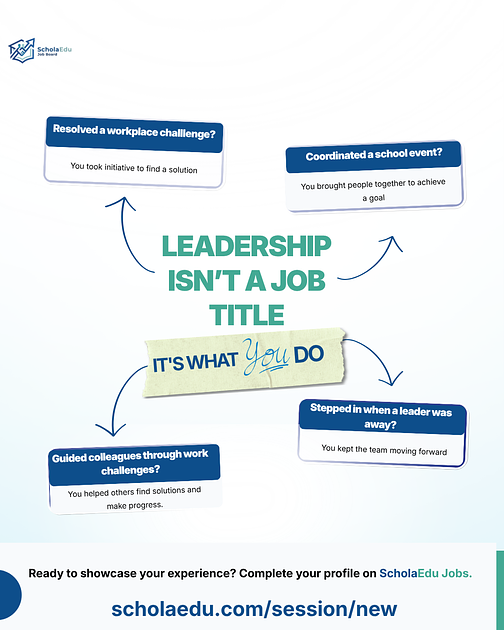
You Don't Need a Leadership Title to Have Leadership Experience
Have you ever considered applying for a school leadership position but hesitated because you have never held a formal leadership title?
Perhaps you have never been a Head of Department, Vice Principal, Principal or School Manager. You may have spent years working as a teacher or in another role within an education organisation, assuming that leadership opportunities are reserved for people who have already held these positions.
But what if you have been developing leadership experience without recognising it?
Did you know that leadership is not limited to formal titles? You may already be demonstrating leadership through the responsibilities you handle, the decisions you make, the problems you solve and the support you provide to others.
The most important question to ask yourself is: Can I recognise these experiences and communicate them effectively when applying for leadership opportunities?

What Does Leadership Experience Look Like Without a Leadership Title?
Leadership is often associated with positions such as Principal, Head of School, Director, or Regional Manager. While these positions come with formal authority and responsibilities, leadership can also be demonstrated through the work people do in their existing roles.
Consider some examples.
1. You Support and Guide Your Colleagues
Have colleagues ever approached you for guidance at work? Perhaps you have helped a new teacher understand school procedures, supported a colleague with classroom management, or helped team members solve a problem.
These experiences can demonstrate leadership skills such as mentoring, communication, problem-solving, and supporting others to improve.
2. You Take Responsibility Beyond Your Regular Duties
Have you ever taken on a task outside your usual responsibilities to help your school achieve an important goal? Perhaps you volunteered to coordinate a school activity or took responsibility for ensuring a project was completed on time.
These experiences can demonstrate initiative, accountability, organisation and the ability to manage responsibilities beyond your immediate duties.
3. You Step In When a Leadership Position Is Vacant
Have you ever been asked to take over some or all of a colleague’s leadership responsibilities temporarily? Perhaps the Principal resigned, the Head of Department went on leave, or the Regional Manager left before a replacement was appointed.
Even if your job title did not change, these responsibilities could demonstrate your readiness for a leadership role.
4. You Help Coordinate People and Activities
Have you ever prepared students for a spelling bee or debate competition? This may involve getting students ready for the event, communicating with parents and school leadership, coordinating logistics, and ensuring everything runs smoothly.
This also means identifying potential challenges and planning solutions ahead of time.
These responsibilities demonstrate planning, collaboration, communication, problem-solving, and the ability to coordinate people and resources towards a shared goal.
5. You Identify Problems and Take Initiative to Solve Them
Have you ever noticed a problem at work and taken steps to improve how things are done? Perhaps you introduced a better system for tracking student attendance or suggested a more effective way to organise student records.
These experiences demonstrate your ability to take initiative, solve problems, and improve existing processes.

How to Communicate Your Leadership Experience on Your CV
Recognising your leadership experience is an important first step. You must also know how to present it clearly and accurately to potential employers.
You do not need a formal leadership title to demonstrate leadership skills. Equally, you should never change your official job title to make your experience appear more senior than it was.
Instead, keep your job title accurate and highlight the additional responsibilities you handled and the achievements you made.
Keep Your Official Job Title Accurate and Highlight Your Achievements
Suppose you worked as an English Language Teacher but were also given additional school management responsibilities by the school owner.
Rather than describing yourself as a School Manager or Director of Education when you did not officially hold that title, retain your actual job title and highlight your responsibilities and achievements.
For example:
English Language Teacher (with Additional School Management Responsibilities)
- Improved English Language assessment scores for 30 pupils, with 24 achieving at least a 15% increase in their end-of-term results through targeted lessons and additional learning support.
- Led student preparation and coordinated the school’s annual spelling bee for three consecutive years, achieving first-place wins in all three competitions.
- Led a pupil enrolment drive in collaboration with fellow teachers, contributing to the enrolment of 50 new pupils within one term.
If you were formally appointed to act as a School Manager or another leadership position, you can state the acting position and its duration on your CV.
The goal is to demonstrate the scope of your experience and the impact of your contributions without misrepresenting your employment history.
When describing your experience, focus on three things:
- The responsibility you took on,
- The action you took, and
- The outcome you achieved.
Where possible, use measurable results to show the impact of your contribution.
For example, instead of simply writing “Assisted with staff coordination,” explain what you coordinated and how it contributed to the team's performance.
Specific examples and measurable achievements help recruiters understand your leadership capabilities better than general statements about being a good leader.
Do Not Rule Yourself Out of Leadership Opportunities
If you have never held a formal leadership position, do not automatically assume you are unqualified to apply for one.
Review the job requirements and consider whether your experience demonstrates relevant leadership skills.
The goal is to recognise the relevant experience you already have, present it honestly, and be prepared to discuss your contributions and achievements during an interview.

Your Experience Matters. Learn to Communicate It.
You do not need to have been a Principal, Head of Department, Regional Manager, or Director to have developed leadership skills.
By supporting colleagues, coordinating activities, solving problems, and taking initiative, you may have gained valuable experience that prepares you for leadership opportunities.
Take time to review your professional experience and identify the responsibilities and achievements that demonstrate your capabilities. Communicate them clearly and accurately on your CV and in your job applications.
Your job title describes your position, but your responsibilities and achievements demonstrate what you can do.
Ready to Showcase Your Experience?
Complete your profile on ScholaEdu Jobs to present your professional experience and explore opportunities that align with your career goals.