Why Your Applications Are Falling Into a Black Hole (And How to Stand Out to Education Employers)
Estimated Reading Time: 3 to 4 minutes
Sign Up Now to receive education job alerts, career tips, and recruitment insights delivered straight to you.
Why Your Applications Are Falling Into a Black Hole (And How to Stand Out to Education Employers)
You see the perfect role online. Your eyes light up, you hit "Apply," and then... silence.
As an educator or education professional navigating today's job market, you've probably experienced this more than once. Whether you're applying to a school, an Edtech company, a nonprofit, a training institute, or any other education organisation, it can feel like your application disappears into a black hole.
But what if the reason you aren't getting callbacks isn't a lack of talent?
After analysing patterns from recent recruitment cycles, I've noticed that many qualified candidates make a handful of preventable mistakes that quietly weaken their chances long before a hiring manager gets to appreciate their experience.
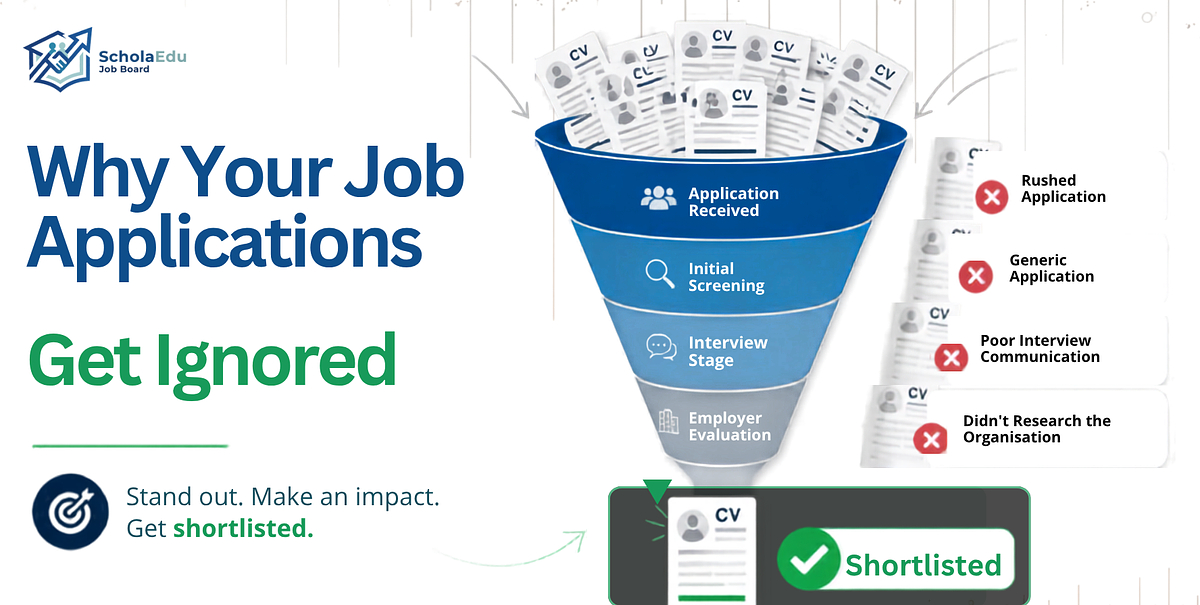
Here are four of the most common mistakes I've identified and what you can do differently to make your next application and interview far more memorable.
1. Rushing the Application and Paying for It Later
In any competitive job market, there's a strong temptation to be among the first people to apply for a newly advertised role. It's easy to assume that speed equals enthusiasm. In reality, speed should never replace precision.
When you rush to submit your documents the moment a vacancy is posted, you increase the chances of making avoidable mistakes. Missing attachments, formatting issues, spelling errors, incorrect file names, or incomplete responses often mean you have to resend your application or, worse, leave a poor first impression.
How to do better:
- Implement a Cool Down review:
- Never hit submit the moment you finish writing.
- Step away for 15 minutes.
- Read your application aloud. Catching that one clunky phrase or missing document before an employer sees it can save your application from the reject pile.
Remember, a flawless application submitted a few hours later will always beat a sloppy application submitted in the first ten minutes.
2. Beware of Regional Misalignment
One of the quickest ways to have your application thrown out is to use heavily generic, imported templates from the internet. A common error is using foreign terminology, such as referencing "school districts" commonly used in the United States when applying to private institutions, schools, and local ministries within your own region.
When you use copy-and-paste cover letters from global websites or AI tools without modifying them, it sticks out like a sore thumb. School proprietors and principals can tell instantly if your application text was written for a school environment across the world rather than the local classroom landscape.
How to do better:
- Make your application feel intentional.
- Speak directly to the environment you're applying to.
- Whether the organisation works with WAEC, Cambridge, Montessori, EYFS, educational technology, teacher development, or another area within education, demonstrate that you understand their work and the challenges they're trying to solve.
That level of relevance makes your application feel grounded and far more credible.
3. Talking Too Much During the Interview
Some candidates believe that the more they say, the more qualified they'll appear.
Unfortunately, the opposite is often true.
In an effort to impress the interviewer, they continue talking long after they've answered the question. They drift into unrelated stories, repeat themselves, or begin explaining things they weren't asked.
I've even seen situations during virtual interviews where the interviewer tries to interrupt by raising a hand or attempting to ask a follow-up question, but the candidate doesn't notice, or maybe they notice and decided to keep talking anyway.
Communication isn't just about speaking well. It's also about listening well.
An interview is a conversation, not a presentation.
How to do better
- Answer the question that was asked.
- Pay attention to both verbal and non-verbal cues. If the interviewer attempts to interject, pause and let them speak. Keep your responses focused, concise, and relevant.
- Remember, you're not trying to prove that you know everything. You're showing that you can communicate professionally and work collaboratively. These are qualities every education organisation values.
4. Walking Into the Interview Without Understanding the Organisation
This happens more often than people realise.
Candidates attend interviews without taking time to understand what the organisation actually does. When they're asked simple questions like: "What do you know about us?", "Why do you want to work here?", "How do you see yourself contributing to our mission?"
Instead of answering confidently, they begin speaking off point because they haven't done their homework.
Sometimes, rather than admitting they don't know something, they attempt to guess.
How to do better
- Before every interview, spend time researching the organisation.
- Visit their website. Read about their programmes, services, values, and recent activities. Explore their social media pages. Understand the audience they serve and the impact they're trying to create.
- Then think about where your own experience fits into that mission.
- And if you're asked a question you genuinely don't know the answer to, be honest. It's far better to admit that you're unfamiliar with something and explain how you'd approach learning it than to confidently provide an inaccurate answer.
The Golden Rule for 2026: Lead With Value
The strongest candidates don't just apply for jobs. They position themselves as problem-solvers.
Instead of treating your CV as a list of previous responsibilities, think of it as evidence of the value you bring. Show employers what you've improved, built, solved, or contributed to, not just where you've worked.
The same principle applies during interviews. Employers aren't looking for candidates who simply talk the most. They're looking for people who understand their organisation, communicate effectively, listen carefully, and can demonstrate how they'll contribute from day one.
Whether you're applying to a school, an education startup, a nonprofit, or any other education organisation, the fundamentals remain the same.
Slow down.
Be intentional.
Do your research.
Listen as much as you speak.
Most importantly, make it easy for employers to see the value you'll bring to their team.
Because when an organisation can clearly see how you'll help move its mission forward, your application is far less likely to disappear into the black hole.
Sign Up Now to receive education job alerts, career tips, and recruitment insights delivered straight to you.