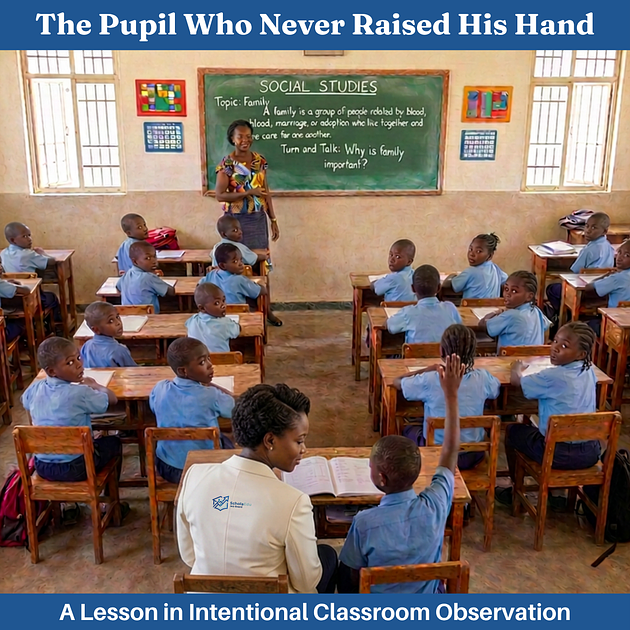
The Pupil Who Never Raised His Hand: A Lesson in Intentional Classroom Observation
By Oluwabunmi Fahuwa
Estimated Reading Time: 5 - 6 minutes
While conducting a classroom observation in 2023, I witnessed a moment that completely changed how I think about teaching, learning, and classroom observation.
Instead of sitting on the teacher's chair, as many classroom observers do. I sat beside the pupils. I wanted to observe not only how the teacher was teaching but also how the pupils were experiencing the lesson.
As I moved around the classroom, I noticed a Primary 5 boy sitting alone.
I sat beside him as the lesson continued.
A few minutes later, the teacher introduced a Turn and Talk activity.
For those unfamiliar with the strategy, Turn and Talk allows pupils to discuss a question with a partner before sharing their responses with the whole class. It gives learners time to process their thoughts, learn from one another, and build confidence before speaking publicly.
It is a simple strategy, but when used intentionally, it can be incredibly powerful.
The Unexpected Partner
When the Turn and Talk activity began, every pupil turned to a partner.
Except the boy sitting beside me.
He had no one to discuss the question with.
So I decided to become his partner.
We talked through the question together. I encouraged him to explain the answer back to me until he felt comfortable saying it on his own.
A few moments later, the teacher asked for a volunteer to answer the question.
Slowly, the boy raised his hand.
He answered correctly.
The teacher smiled and said "Correct".
Then something happened that has stayed with me ever since.
The entire class turned around to look at him.
There was genuine surprise on their faces.
After the lesson, the teacher explained why.
She told me this was a pupil who had never volunteered to answer a question before. Even when called upon, he rarely answered correctly.
That one moment changed something.
Not only did his classmates begin to see him differently, but I believe he also began to see himself differently.
Sometimes, confidence begins with one successful experience.
The Conversation After the Lesson
During my feedback session with the teacher, we reflected on what had happened.
We discussed how a brief conversation before answering the question had given the pupil the confidence to participate.
We also talked about what this experience could mean for him going forward. Having answered correctly in front of his classmates, he was now more likely to volunteer, ask questions, and participate during future lessons.
One successful moment had the potential to reshape how he viewed himself as a learner.
We also discussed the importance of intentionally pairing pupils during collaborative activities.
Rather than consistently grouping high-performing pupils together or allowing pupils to choose the same partners every time, teachers should intentionally pair learners with different strengths so they can support one another.
Every collaborative activity should create opportunities for every learner to participate and grow.
A Lesson for Every Teacher
That classroom observation reinforced something I still believe today.
Teaching is not simply about delivering content.
It is about intentionally creating opportunities for every learner to succeed.
When planning pair work or group activities, don't assume every pupil has a partner.
Look around the room.
Notice who has been left out.
If necessary, become that pupil's partner.
Sometimes, the difference between silence and participation is simply knowing that someone believes in you.
A Lesson for School Leaders and Classroom Observers
This experience also reshaped how I think about classroom observations.
If you're a Head of School, Head of Academics, HOD, instructional coach, or anyone responsible for observing lessons, remember that your observation should not focus only on the teacher.
Observe the pupils just as intentionally.
Move around the classroom instead of remaining in one position.
Sit beside different learners.
Look through their exercise books.
Observe how they are responding to questions.
Listen to their discussions.
Ask yourself:
- Are pupils discussion aligned with the learning objective?
- Are pupils actively engaged in the lesson?
- Is every learner participating?
- How are pupils responding to the teacher's feedback?
- Are they understanding what is being taught?
Teaching and learning happen simultaneously.
A lesson cannot be considered successful simply because the teacher explained the topic well.
The real question is: Did the pupils learn?
When classroom observations focus only on teaching, important evidence about learning is easily missed.
Final Reflection
That Primary 5 boy probably doesn't remember that classroom observation.
But I do.
Not because he answered a question correctly.
But because he reminded me that intentional teaching isn't always about changing an entire classroom.
Sometimes, it's about changing one learner's experience.
As educators and school leaders, we have the privilege of creating classrooms where every learner feels seen, included, and confident enough to participate.
Sometimes that begins with a thoughtful teaching strategy, an encouraging conversation, or simply choosing to sit beside a pupil instead of observing from the front of the classroom.
Because the true measure of a successful lesson isn't how well the teacher taught.
It's how well the pupils learned.
Enjoyed this insight?
Join the ScholaEdu community to receive practical articles, classroom strategies, school leadership insights, and the latest education job opportunities—delivered straight to your inbox.